JUF and You

Subscribe to JUF's
e-mail newsletters:

The Guide
The Guide to Jewish Living in Chicago
offers a comprehensive, up-to-date listing of Chicago-area Jewish organizations, resources, products, and services.
Memorials & Celebrations
Celebrating, rejoicing or sending love to a friend in need? JUF has a card or certificate designed just for you.
E-mail this page   E-mail this page      Print this page   Print this page      Bookmark and Share

From the Universal to the Particular

Yehiel Poupko
Thinking Torah

It is now the Jewish year 5770 since creation, and with Simchat Torah we conclude the Torah reading cycle for 5769 and we begin the Torah reading cycle for 5770. We find ourselves at the beginning of B’reisheet. These are the most familiar narratives in the Torah. There is a critical organizing principle found in the opening chapters of the Book of B’reisheet-Genesis that goes to the very nature of Judaism.

Adam and Eve, two individuals, birth all humanity. They sin. Their son Cain surely sins. After that humanity continues to sin and is wiped out in the flood. A new individual, a second Adam if you will, is brought forth, Noah. Once again he births all of humanity, and once again humanity sins. God then identifies a third Adam, Abraham, and now everything changes. Abraham will not become the father of humanity. He and Sarah will birth only one family, that will become only one clan, that will become only one nation, that will remain after all, but one family.

This one family will have the responsibility to teach humanity how to live according to God’s plan for justice, righteousness, holiness, and purity. This one family—specific, particular, parochial, and small in number—will by its way of life, teach humanity about the one, universal God. It stands to reason that since there is but the one universal God, then God should deal with all of humanity, as He did in the Torah prior to Abraham; and that He should establish a universal religion.

The Torah starts out with all humanity, a universal vision of everyone having the same responsibilities and obligations, because everyone is created in the image of the One God. That fails twice. After that failure God in effect says, “No, I will not deal with all humanity. Rather, one specific people will present the universality of My being and My ways.” In other words, Abraham, who knows the one universal God, becomes the father of a system of belief and practice commanded by the one universal God, which is suited for only one particular people. The universal God births the parochial faith, Judaism, practiced only by the Jewish people.

Thus, God makes the Covenant of Peoplehood with Abraham and Sarah, which means that their children are chosen for special responsibility. Their task is to bring brakha-blessing to the world by keeping the Torah. The Covenant of Peoplehood blossoms into the Covenant of Torah and Mitzvot, made at Sinai with the Jewish people. This covenant spells out in great detail what is expected from the children of Abraham and Sarah. The one God, who created the universe, and created all humanity in His image, establishes a specific, well-defined religion by which only one people will make known His basic teaching to the world. This is the organizing principle of the Torah, the move from the universal to the particular. 

Why would the one universal God not promulgate a universal religion? Why does the one God with a universal message choose one family and one people to establish a system of faith suited for only one people? 

Following the flood, we read of the children and the nations that emerge from the three sons of Noah. We are told, “these are the descendants (of the children of Noah)…according to their clans, their cultures, their lands, and their nations.” In this deceptively simple passage, the Torah affirms that every human being is created in the image of God, and is a unique individual. Unique individuals will develop families and nations with unique and diverse languages and cultures. This is the way of the world. Universalism is not the way of the world. The way of the world is its sheer immense diversity, each nation with its own language and its own culture. The promulgation of one faith for all people is unnatural and contrary to the Torah’s belief in the development of specific cultures by each nation. It is an abstraction that erases the beauty of human creativity. 

After the development of national cultures by Noah’s descendants, something strange happens. An individual comes along and begins to wander in search of the one God. It is God who seeks out Adam. It is God who seeks out Noah. It is Abraham, on the other hand, who seeks out God. Abraham pursues God. That is why one of our classic prayers refers to God as the “God of Abraham.”  Abraham pursued God, and acquired Him. Abraham’s pursuit of God is recognized by God. Following God, who cannot be seen, touched, heard, or in any other way sensed, is very difficult. This is faith and religion for the strong of heart. It is not for everyone.

The vehicle for this faith must be as powerful as the difficulty of the task. Judaism begins in a family and continues with a nation that remains a family. Judaism is a family that became a faith. The fierce unconditional love of family members is the setting in which this challenging faith in the one God is lived and transmitted. This fierce love of family members for each other prepares, trains, and conditions its members, the Jewish people, to have the same uncompromising love for this one God and for Judaism. That is why belief in the one God is taught to the Jewish nation at Sinai only after it has been lived in the family setting by its first family members, Abraham and Sarah, Isaac and Rebecca, Jacob, Rachel and Leah. 

God declares to Abraham: “For I have known him (Abraham) by experience, as he instructs his children and their family that they will keep the ways of God to do righteousness and justice.” What does God know about Abraham? Again, and again Abraham pursues the ways of justice and righteousness. For this reason God falls in love with Abraham. Because of that, God loves the children of Abraham and Sarah, for in them He sees their parents, with whom He has fallen in love. In the very next verse, right after God expresses the love for Abraham and Abraham’s children that He will express for no others, an amazing thing happens. Abraham turns to God on behalf of others, the sinful people of Sodom and Gomorrah, and demands justice and righteousness for them. 

This then is the message of B’reisheet-Genesis. The Jewish people teach the world the ways of the one universal God through its particular religious life. In the fierce love of immediate family, the Jew models love for all of humanity.  od’s fierce love of the particular Jewish people ever drives this particular Jewish people to practice Judaism in all its particularity. This passionate, particular way of serving the one God, served and continues to serve as a model for humanity. The universal is attained through the particular and the familial.

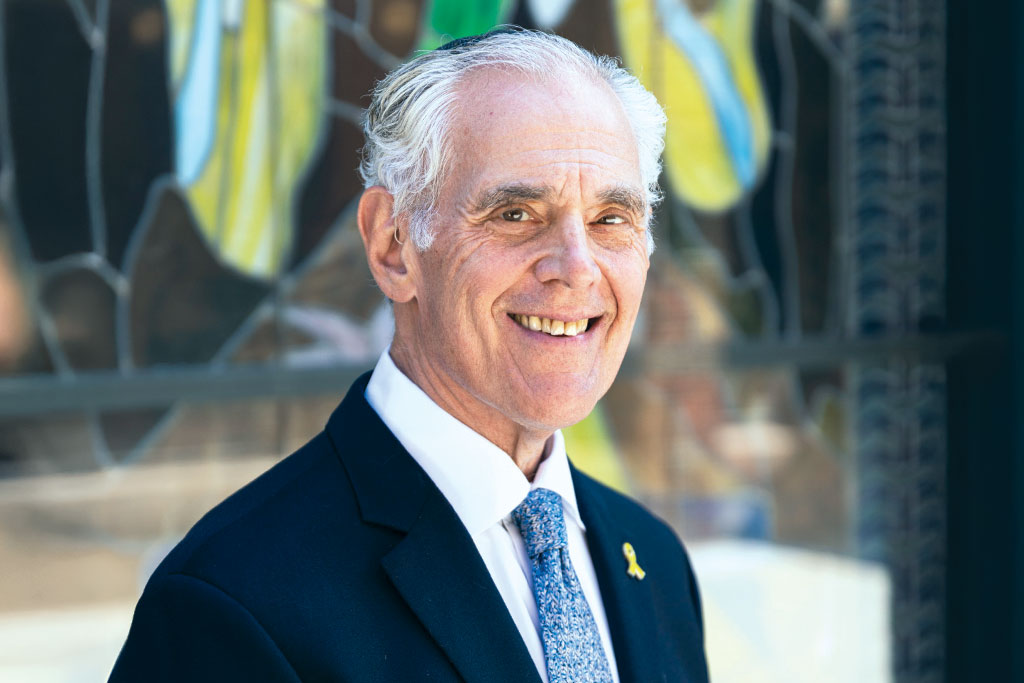
Rabbi Yehiel E. Poupko is Judaic Scholar at the Jewish United Fund/Jewish Federation of Metropolitan Chicago.

Posted: 10/1/2009 2:01:08 PM

Content Rating

  Average 0 out of 5