JUF and You

Subscribe to JUF's
e-mail newsletters:

The Guide
The Guide to Jewish Living in Chicago
offers a comprehensive, up-to-date listing of Chicago-area Jewish organizations, resources, products, and services.
Memorials & Celebrations
Celebrating, rejoicing or sending love to a friend in need? JUF has a card or certificate designed just for you.
E-mail this page   E-mail this page      Print this page   Print this page      Bookmark and Share

The Ashes of Isaac

We are in the season when the Torah reading brings to conclusion the third book, Vayikra-Leviticus. It is also the season in which we commemorate Yom Hashoa, Holocaust Remembrance Day. How does Vayikra lend this season meaning? At the close of Chapter 26, we read that if the Jewish people sin, we will be exiled and dispersed amongst all the nations of the world, which persists to this day; and that in the end, God will remember His covenant:

Then will I remember my covenant with Jacob; and also My covenant with Isaac; and also My covenant with Abraham will I remember.

And in God’s remembering we are promised return home. The rabbinic masters of the second century are struck by the fact that the word zakhor, remember, is not found in reference to the covenant with Isaac. God promises to remember the covenant made with Abraham and with Jacob—a promise made in the face of the possibility of forgetting. Forgetting the oath made to Isaac is not possible, the Midrash says, because there is something of Isaac ever present with God. The rabbis teach, God declares, “Afro shel yitshak munakh l’fanai tamid – the ashes of Isaac are ever heaped before Me.” This refers to that Midrash which tells us, if the ear can bear to hear it, that on that altar, on Moriah, long ago, Isaac was reduced to ashes, and later resurrected, brought back to life.

The ashes of Isaac guide us in the ways of memory, which we sometimes run from as it threatens to drown us in despair. How does one remember both individual pain and national loss? The Jewish people are in fact nothing if not the people of memory. The ashes of Isaac instruct us by a lesson in simplicity, and plain honesty. For contrast we turn to Rosa Luxembourg, born in Zamosc, Poland, to a traditional Yiddish-speaking Jewish family. When she moved to Warsaw she became intoxicated with socialism and communism because of a passionate Jewish commitment to justice and to alleviating human suffering. Rosa Luxembourg, one of the two founders of the Communist Party in Germany, was arrested in Berlin on Jan. 15, 1919, and murdered. She wrote one of the most remarkable Jewish letters of the 20th century. When challenged by a Jewish friend as to why she never took up any cause of the Jewish people, she responded:

“Why do you come with your particular Jewish sorrow. I feel equally close to the wretched victims of the rubber plantations in Putumayo, or to the Negroes in Africa with whose bodies the Europeans are playing catch ball… I have no separate corner in my heart for the ghetto. I feel at home in the entire world wherever there are clouds and birds and human tears.”

Rosa Luxembourg’s universalism allowed no room in her heart for Jewish suffering or memory.

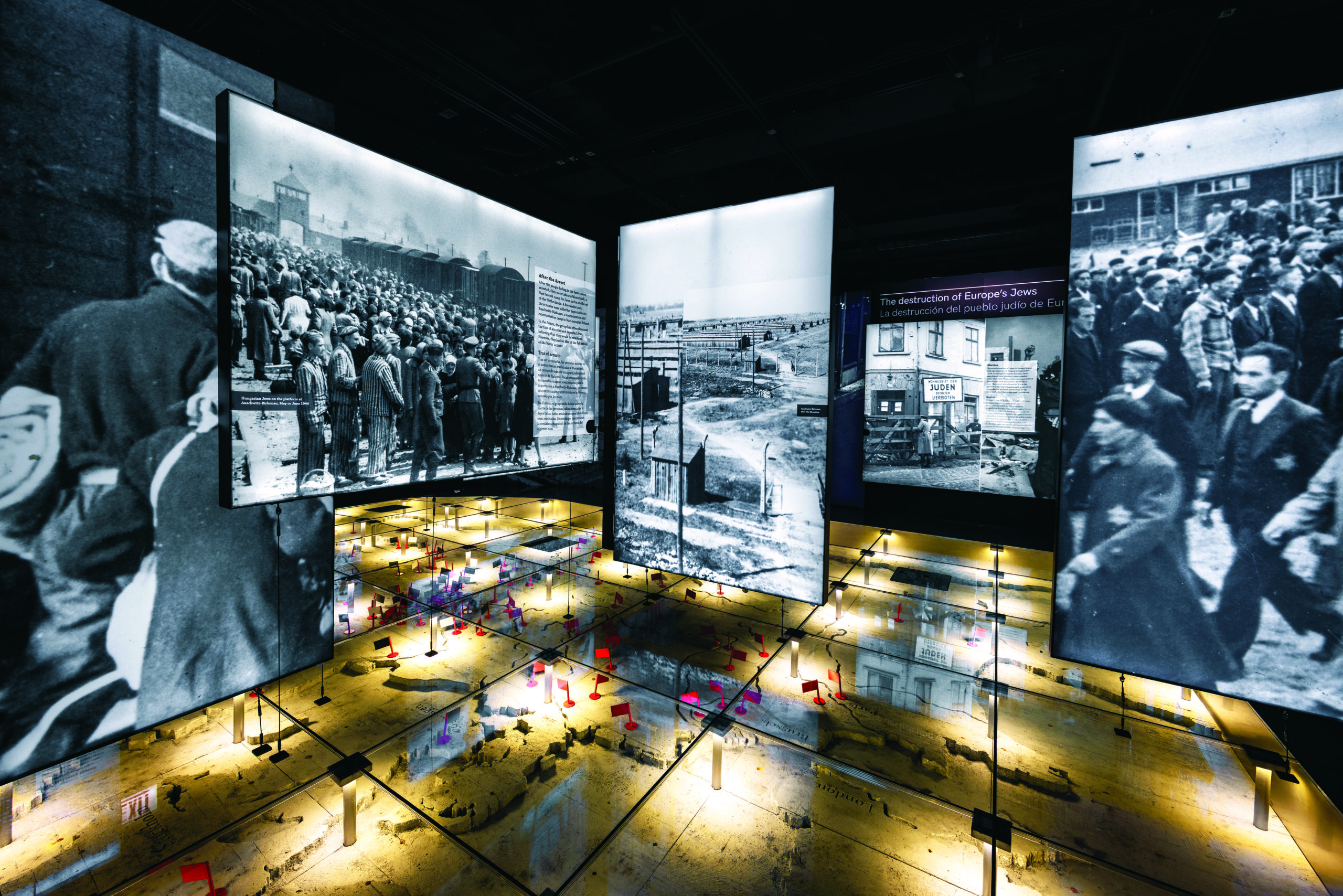
This midrash on the ashes of Isaac teaches a different lesson. The Jewish commitment to universal justice and to the relief of suffering always begins with and never departs from the particular, the ashes of Isaac, which blanket Europe and North Africa—heaped in a 5,000-cubic-foot mound in Majdanek; scattered in more than 600 mass-murder sites in Ukraine; buried in Ponary just outside Vilna, the Jerusalem of Lithuania, and found in the idyllic pond next to the crematoria in Birkenau (Auschwitz II). The ashes of some 33,700 Isaacs are strewn in the forested ravine of Babi Yar of Kyiv.

And so today we are archaeologists, searching for clues and images about the life lost. With memory, mourning becomes the inspiration for building a rich Jewish civilization. Sifting through the ashes of Isaac, we find so many Isaacs and Rivkele’s: people who no longer speak Yiddish, sometimes speak French better than the French, dress like the Belgian, and play classical music like the German—people almost at home in these Western enlightened societies that once promised equality but were soon to betray them. Sometimes Isaac and Rivkele seem so different from one another, yet the Parisian Jew and the Vilna Jew each acknowledge every year on Passover, “in each and every generation, each and every person should see him or herself as if he or she went forth from Egypt.” They both know they share the same flesh and family, the same destiny.

The varieties of Jewishness become ever more complex in the great Jewish population centers of Eastern Europe, where demographic analysis shows that a significant proportion of murdered Polish and Hungarian Jewry kept Shabbat and Kashrut, and yet spoke the same Yiddish as the fiery Jewish socialists clamoring for justice and equality born of the prophets’ vision. We remember too that in the summer of 1941, the Jewish world lost its greatest center of Talmudic scholarship, when the Yeshivas of Lithuania were murdered, and that in 1942-1943 the Jewish people lost the single largest group of trade union members.

The scholar Yehuda Bauer notes that while the destruction of European Jewry was unprecedented, the moment it took place in became precedent, bequeathing to society words to describe human suffering: holocaust, ghetto, genocide, selection, death squad, and more. But there is a challenge. When a particular experience births a universal lesson, the particular experience is at times forgotten. The universal lesson retains efficacy and authenticity only if it remains faithful to the experience out of which it is born. Thus we sift through the ashes of Isaac and Rivkele to remain faithful to the Yiddish-speaking socialist, trade unionist, Yeshiva student, Zionist, occasionally converted-to-Christianity Jews, and all those ordinary precious Jews murdered only because they were Jews.

We sift through the ashes of Isaac lest we forget in our pursuit of the universal that after all, only Rivkele and Isaac were murdered. Once we learn that, and learn it well, then we can draw the broader lesson: only the ashes of Isaac are ever heaped before God and that is where memory and authenticity ever reside.

Rabbi Yehiel E. Poupko is Judaic Scholar at the Jewish United Fund/Jewish Federation of Metropolitan Chicago.

Posted: 5/5/2009 11:02:12 AM

Content Rating

  Average 0 out of 5