JUF and You

Subscribe to JUF's
e-mail newsletters:

The Guide
The Guide to Jewish Living in Chicago
offers a comprehensive, up-to-date listing of Chicago-area Jewish organizations, resources, products, and services.
Memorials & Celebrations
Celebrating, rejoicing or sending love to a friend in need? JUF has a card or certificate designed just for you.
E-mail this page   E-mail this page      Print this page   Print this page      Bookmark and Share

Some Enchanted Evening

To some degree the popularity and the enduring success of the annual Passover family Seder is indebted to McDonald’s and to Martha Stewart. McDonald’s articulated very early on the powerful combination of food, family, and fun. Its shaping of American culture and eating habits has surely had its impact on the popularity of the Seder, which is also a combination of food, family, and fun.

Martha Stewart resurrected the family ritual meal. Emerging, as she did, in the ‘80s, she understood that the chaos and the upheaval of the ‘60s had left many Americans with few ritual meals. The dining room table was empty. A generation of Americans had grown up not knowing how to celebrate special times with special meals. Her earliest shows were about the Thanksgiving meal and July 4th. She understood that Americans really wanted a Thanksgiving dinner, but many of them simply didn’t know how to make it. They had forgotten how to set the table and how to prepare its various foods. The Passover family Seder has for the past several decades benefited from all kinds of Jewish imitations of Martha Stewart: workshops, model set Seder tables, recipes, and the proliferation of Passover cookbooks, including one by the New York Times.

This is surely to the good. It’s not unprecedented for the Seder to benefit from the host culture. While the mitzvot and rituals of the Seder are the products of the Torah and the Talmud, some of its features as a celebratory meal are indebted to similar meals in Hellenistic culture. The question we then face is: Is there more to the family Seder than just a McDonald’s understanding that food in the family setting adds up to fun; and the Martha Stewart insight of the power of nostalgia for authenticity in family meals?

From its very inception the Passover Seder has been a family meal. That is the way the Torah established it. 

The LORD said to Moses and Aaron in the land of Egypt: 2 This month shall mark for you the beginning of the months; it shall be the first of the months of the year for you.  3 Speak to the whole community of Israel and say that on the tenth of this month each of them shall take a lamb to a family, a lamb to a household. Exodus 12:1-3

In the days of the Beit Ha-Mikdash, families would gather on the slopes of the Temple Mount in a sacred picnic to eat the Passover lamb with matza and maror-bitter herbs. Thus did this Seder family meal continue down to our times. Its setting has always been home and family. Why is this so? There is a passage in the Haggadah, quoted from the Book of Joshua. It is a famous passage found in all our Haggadas. Whenever a great text like the Haggadah quotes verses from the Bible, the rabbis are asking us to do more than just read the quoted verses. They want us to know the larger text from which the selection is taken. Michelangelo regularly went to the quarry outside of Florence to study the cliff, or stone formation, from which a block of marble was hewn. Without that context he felt he couldn’t fully grasp the piece of stone before him. What follows (in bold) is this selection, as found in the Haggadah, in its larger context in the Book of Joshua.

Joshua assembled all the tribes of Israel at Schechem. He summoned Israel's elders and commanders, magistrates and officers; and they presented themselves before God. 2 Then Joshua said to all the people, "Thus said the LORD, the God of Israel: In olden times, your forefathers—Terah, father of Abraham and father of Nahor—lived beyond the Euphrates and worshiped other gods. 3 But I took your father Abraham from beyond the Euphrates and led him through the whole land of Canaan and multiplied his offspring. I gave him Isaac, 4 and to Isaac I gave Jacob and Esau. I gave Esau the hill country of Seir as his possession, while Jacob and his children went down to Egypt. 5 "Then I sent Moses and Aaron, and I plagued Egypt with the wonders … after which I freed you… 11

"Then you crossed the Jordan and you came to Jericho…13 I have given you a land for which you did not labor … 14 "Now, therefore, revere the LORD and serve Him with undivided loyalty; put away the gods that your forefathers served beyond the Euphrates and in Egypt, and serve the LORD. 15 Or, if you are loath to serve the LORD, choose this day which ones you are going to serve—the gods that your forefathers served beyond the Euphrates, or those of the Amorites in whose land you are settled; but I and my family will serve the LORD." 16 In reply, the people declared, "Far be it from us to forsake the LORD and serve other gods! 17 For it was the LORD our God who brought us and our fathers up from the land of Egypt, the house of bondage… We too will serve the LORD, for He is our God." Joshua 24:1-6, 11-18   

In the boldface is the passage found in the Haggadah. It is used by the Haggadah to fulfill the literary formula the rabbis set forth for the telling of the tale of the Exodus from Egypt. The narrative must begin with the shame of the Jewish people and conclude with their praise. The shame of the Jewish people is that we are the children of pagans and idolaters. Our grandfather was Abraham and our great-grandfather Terah, was an idol-worshipper.
But when we look at the quarry cliff of this passage, out of which this passage was hewn, we discover something else. This is the deathbed speech of Joshua. Joshua is the student, disciple, and apprentice of Moses. Moses dies in the desert. It is Joshua who takes the Jewish people across the Jordan River, to the Land of Israel, conquers the Canaanite nations, and apportions the land to the Twelve Tribes of Israel. As he is about to die, he gathers around him the heads of the various tribes and clans, the elders, and all Israel. Like any great national leader, before he dies he recites the people’s history, and then he challenges them.

What is the challenge of Joshua that the rabbis who chose this passage for the Haggadah want us to know and remember, and indeed, reaffirm on Passover night? Joshua begins by telling those around him that our national origins are in idol worship. We went down to Egypt. We were slaves. God redeemed us. God kept the oath made to Abraham that his children would then be given the Promised Land. Sure enough, under Joshua’s leadership they have attained all that. Now here comes the surprise. Having recited all of this, Joshua then declares:

14 "Now, therefore, revere the LORD and serve Him with undivided loyalty; put away the gods that your forefathers served beyond the Euphrates and in Egypt, and serve the LORD. 15 Or, if you are loath to serve the LORD, choose this day which ones you are going to serve—the gods that your forefathers served beyond the Euphrates, or those of the Amorites in whose land you are settled; but I and my household will serve the LORD." Joshua 24:14-15 

Joshua tells us that after the Exodus from Egypt, the revelation at Sinai, the miraculous experience in the desert, and the conquest of the Promised Land, there were still Israelites that were worshipping idols and alien gods. He tells them to remove those gods that their ancestors worshipped on the other side of the river (meaning the father of Abraham) and in Mitzrayim-Egypt.

Then Joshua does something that I don’t think any other Jewish leader has ever done. He has a level of boldness and clarity that is staggering. Joshua is saying, and if you don’t want to worship the One God then choose today whomever you want and go worship that god. Joshua actually gives the Jewish people a pass, a way out. He says at this critical moment, when all the promises of God are fulfilled, you have a chance to opt out.

Then comes the question, if that is so, how will the Jewish people continue? And here Joshua gives us the answer that is realized only on this night of the Passover Seder. Even if all the Jewish people should decide to go worship idols, Joshua is not worried. Why? As he says, “I and my family will serve the One God.” What is Joshua saying? Just as the Jewish people began with one family; the Jewish people can be renewed by one family. His one family is enough.

The reason the rabbis want us to know this passage in Joshua 24, is to remind us that the essence of the Passover Seder is exactly this. The entire Jewish people could in fact start all over again and be reconstructed from just one, any one Jewish family that has chosen to sit at the Seder table, re-living and re-telling all of Jewish history. This is the transformative power of the Passover Seder. Any Jewish family that sits down in the loving environment of family on Passover night, and tells the tale of the first Jewish family, Abraham and Sarah; and how they left Ur of the Chaldees because of their belief in the One God; and how that family became a clan; and how that clan became a sacred nation with a purpose; that then went into slavery and was redeemed by God; and received the Torah; and came to the Land of Israel… any family that tells that tale; and then concludes the tale with the valedictory statement: In each and every generation, each and every Jew is obligated to see him or herself as if he or she went out from slavery in Egypt… is quite simply a family that has transported itself back to the very moment of the birth of the Jewish nation and is prepared, like the family of Abraham and Sarah, and the family of Joshua, to start the Jewish people all over again if, God forbid, that is necessary.

This can only happen on Passover night at the Seder. It is this that has made the Passover family meal so very enchanting and magnetic, thousands of years after its inception. Each family, in telling the tale, in returning to the beginning, can become the beginning.

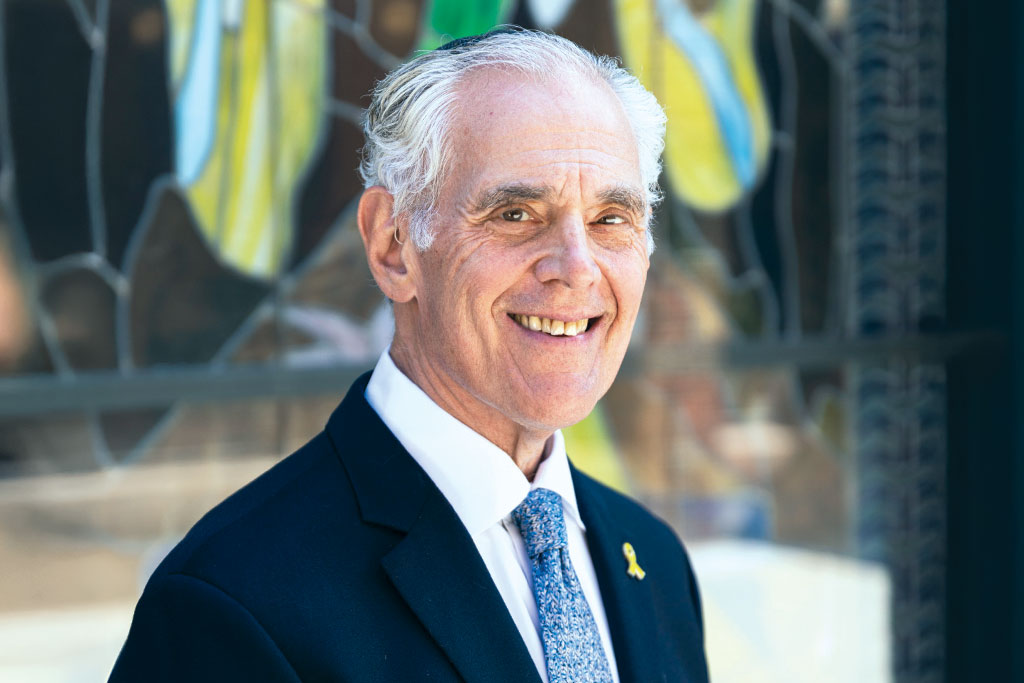
Rabbi Yehiel E. Poupko is Judaic Scholar at the Jewish United Fund/Jewish Federation of Metropolitan Chicago.

Posted: 4/7/2009 1:32:34 PM

Content Rating

  Average 0 out of 5