JUF and You

Subscribe to JUF's
e-mail newsletters:

The Guide
The Guide to Jewish Living in Chicago
offers a comprehensive, up-to-date listing of Chicago-area Jewish organizations, resources, products, and services.
Memorials & Celebrations
Celebrating, rejoicing or sending love to a friend in need? JUF has a card or certificate designed just for you.
E-mail this page   E-mail this page      Print this page   Print this page      Bookmark and Share

Taking on the new anti-Semitism

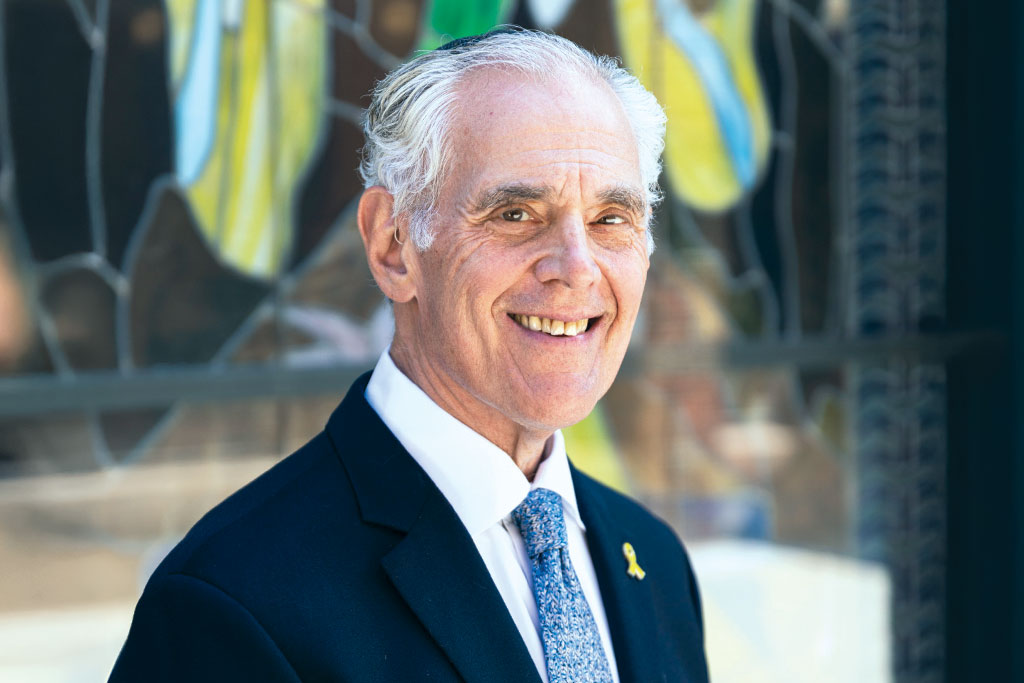
Michael Kotzin

“For four hundred years now, Jewish people have lived in the shadow of this Shylock. In the modern world, the Jew has been perpetually on trial; still today the Jew is on trial, in the person of the Israeli.” Philip Roth, Operation Shylock, 1993.

For traditional anti-Semitism it was individual Jews, Jewish communities, and the Jewish people who were maligned, discriminated against, and ultimately singled out for annihilation. Today the central target is the Jewish collective as constituted in the State of Israel, with individual Jews around the world increasingly targeted for their identification with that country. And in numerous settings today the intent is to deny Israel its place in the family of nations or even, in the words of the president of Iran—a country that is developing a nuclear capability—to wipe Israel off the map. In short, anti-Zionism, which rejects the Jewish people’s right to sovereignty in their ancient homeland, is the new anti-Semitism, and the danger it poses is very real.

Overlaid on this contemporary template are manifestations of the old anti-Semitism. Driving that was the Christian belief that the Jews, in killing Christ and continuing to reject him as their lord, deserved to be superseded by Christians as God’s chosen people, with the Church the new Israel. The anti-Zionists of today, in their turn, see the Palestinians as having superseded the Jewish people as the true heirs to the land of Israel. Basing themselves on biblical texts, Christian theologians maintained that whatever right the Jewish people may previously have had to the land of Israel was forfeited by their violation of God’s commandments. Today one hears voices in the Christian world, even Evangelical ones, echoing that concept in a contemporary context. And with the Palestinians seen as the new Jews, the Jews of Israel are portrayed as the new Nazis, themselves the persecutors of today’s pitied victims.

From another perspective, the new anti-Semitism reflects continuity from the old, drawing upon its themes and images. Whereas traditional anti-Semitism projected the image of the Jew as a conspiratorial, demonic being out to rule the world, as promoted in a classic form by the Protocols of the Elders of Zion, that image, and that malevolent text, have been given new life in the Muslim world. Whereas Jews from medieval Europe to 20th-century Germany were scapegoats for the world’s ills, today Israel is blamed for destabilizing the Middle East and for provoking violent but innocent seekers of justice to hate Israel and its friend the United States. In enlightened America, two professors from distinguished universities have written a bestselling tome that promotes a polite variant of these views, asserting that a sinister “Israel Lobby” leads the U.S. to act against its own interests.

Details of the new anti-Semitism can be elaborated on and documented, as they surely will be in this conference. But the issue I would like to briefly raise here has to do with the challenge of helping the world understand that the new anti-Semitism exists and that it represents a serious danger.

What we are up against is a situation where people like Professors Mearsheimer and Walt, not to mention Jimmy Carter, claim that the charge of anti-Semitism is a smokescreen used to silence them and others in expressing what they characterize as mere criticism of Israel. Defending themselves against such a charge and separating themselves from those who are “challenging Israel’s right to exist or questioning the legitimacy of the Jewish state,” Mearsheimer and Walt assert that for them “the history of the Jewish people and the norm of national self-determination provide ample justification for a Jewish state.” All the same, throughout the pages that follow those words, in their book they rationalize and minimize the anti-Israel animosity of people and groups who do not share that belief. They ignore the blatant anti-Semitism of a figure like Sayyid Qutb, ideologue of the Egyptian Muslim Brotherhood, whom they describe as a mere “dissident.” They declare that the terrorists who hate Israel are different from the terrorists who hate America, and they tell their readers that those who hate America do so precisely because of America’s support for Israel. In other words, however much they may protest otherwise, their book projects the view that it really is not a very serious offense to oppose Israel’s legitimacy, but it is self-destructive for America to actively support that state as it does.

How should we counter this sophistry? What do we do in a world where other academics too claim to resent hearing the phrase “anti-Semitism” applied to the extreme anti-Zionism that they bluntly promulgate and make the disingenuous countercharge that supporters of Israel who criticize them are attempting to stifle their free speech?

On the one hand, I believe we cannot allow ourselves to be intimidated into not using the label “anti-Semitism” when it is appropriate. On the other hand, though, I would posit that it is incumbent upon all of us to use that term with care. And mere use of the words “anti-Semitism” is not sufficient. We need to attach to them an argument that makes clear what is happening today and what is at stake. We need to insist that while it certainly is acceptable to raise questions about the policies of Israel’s government, as it is about the government of any country, it is not acceptable to single Israel out as the one country on the face of the globe whose very legitimacy is up for debate. Along with insisting that the Jewish people have an unequivocal right to sovereignty and self-determination in the land of Israel, we must expose and counter the hate-filled undercurrents of today’s verbal assaults on Israel and its supporters. 

In sum, we need to demonstrate that we are not engaging in idea-stifling name-calling but are advancing an awareness of the re-emergence of a corrosive mindset, detached from reality and fairness, that has been seen before and has historically triggered and justified horrifying behavior. That is what we are talking about when we condemn anti-Zionism as the new anti-Semitism, and that is what we need to declare in a sophisticated, articulate, persuasive fashion. In helping us to do that, this conference is performing an extremely important role.

Michael C. Kotzin is the executive vice president of the Jewish United Fund/Jewish Federation of Metropolitan Chicago.

Posted: 4/8/2008 10:08:05 AM

Content Rating

  Average 0 out of 5